
What is PHP, and why does almost every website depend on it?
Think of a website like a restaurant. The part customers see, the menu, the tables, the decor, is the front end. But behind the swinging kitchen doors, something has to cook the food, take the orders, and keep the whole place running. PHP is one of the most common “kitchens” on the internet. It is a programming language that powers the behind-the-scenes work on millions of websites: processing your login, showing your shopping cart, booking your appointment.
Most visitors never see PHP and most business owners do not know their website runs on it, the same way a diner does not need to know who the chef is. But when something goes wrong in that kitchen, every table in the restaurant feels it. That is exactly what happened in October 2026.
What happened on October 21 and 22, 2026?
Security researchers discovered a serious flaw in PHP itself, nicknamed PHP2Shell in security coverage, and attackers began building ways to exploit it within hours of the discovery becoming public.
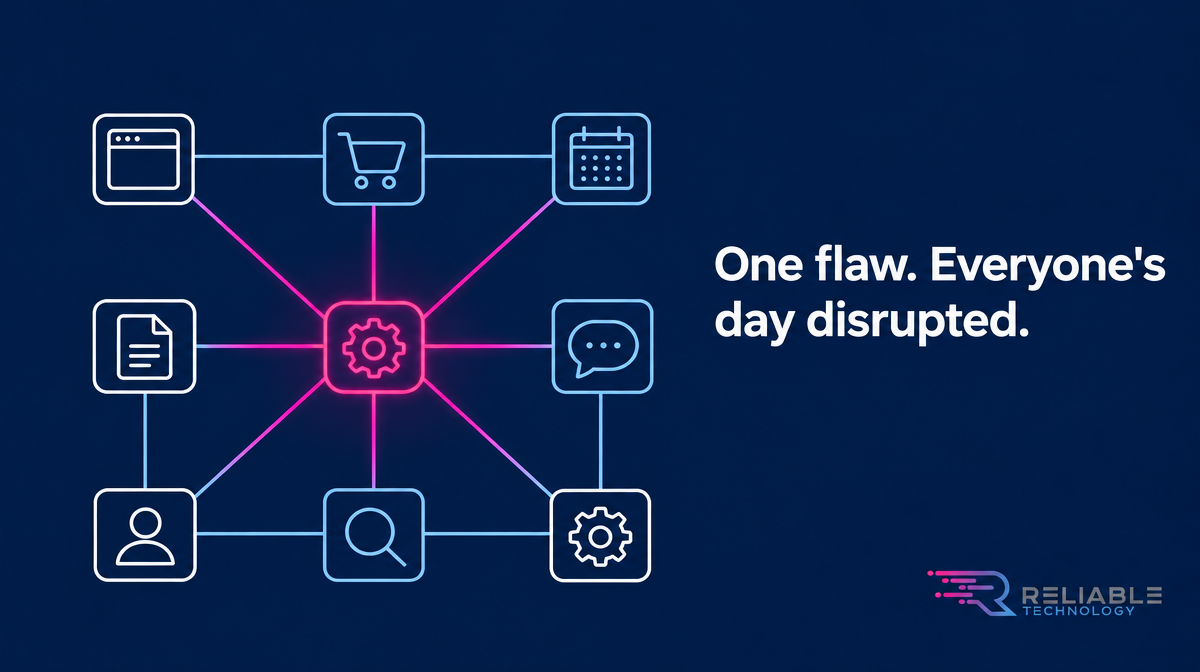
The flaw let an attacker send a specially crafted request to an affected website’s server and run their own commands on it, without needing a username or password first. Because the problem lived inside PHP itself rather than inside any single company’s website, it was not limited to one business or industry. It touched any website, booking tool, or online store built on an affected version of PHP, including systems many small business owners did not realize were running it at all.
The United Kingdom’s National Cyber Security Centre and the United States National Security Agency both issued urgent advisories telling organizations to patch (update) their systems immediately, which is a strong signal of how seriously government security agencies on both sides of the Atlantic treated this. Reuters reported that network infrastructure provider Cloudflare recorded millions of exploit attempts in the days following the disclosure, as attackers around the world scanned the internet looking for servers that had not yet been fixed. Hosting providers and site owners worldwide pushed emergency updates in the days that followed, and some websites went offline temporarily while those updates were applied.
Why this matters more for small and midsize businesses
A large company often has an in-house team watching for exactly this kind of alert, ready to patch within hours. A small or midsize business usually does not. The website might have been built years ago by a freelancer or an agency that is no longer involved, and nobody is checking whether the software underneath it still gets updated.
That gap is the real risk. It is not that small businesses were targeted specifically. It is that an unpatched, unmonitored website is an easy target compared to one that is actively maintained, and attackers were scanning for exactly that kind of target at scale. A business running an online store, a client portal, or an appointment booking page on an affected PHP version could have been exposed without anyone noticing until something went wrong: a defaced page, stolen customer data, or a site that simply stopped working.
In practice, this means the owner of the website matters as much as the code itself. If no one is responsible for watching for alerts like this one and applying fixes quickly, the business is relying on luck.
The bigger pattern behind this event
This was not a hack of one company. It was a flaw in a shared ingredient, discovered publicly, with attackers worldwide trying to exploit it everywhere it existed before it could be patched. Events like this happen periodically because so much of the internet is built on a small number of shared tools. When one of those tools has a problem, the effects ripple outward to businesses that never thought of themselves as a target.
How Reliable handles it
Reliable’s cybersecurity services include 24/7 security monitoring so that when a critical flaw like this is disclosed, patching and remediation can start without waiting for a business owner to see the news first. Reliable also helps Partners understand which of their systems, including websites and the tools built on top of them, depend on software that needs regular attention.
Reliable does not build or host websites, and it does not claim to catch every disclosure the moment it happens. What it does is make sure someone is accountable for watching, patching, and documenting the systems a business depends on, so a flaw like this does not sit unnoticed for weeks. This kind of monitoring and response is included in every Care plan.
If you do not know whether your business’s website or software depends on tools like PHP, or who is responsible for patching them when a flaw like this is disclosed, our free Technology Risk Review is a practical place to start.
Prefer to talk it through with a person? Call (972) 829-5300 and a real person in Frisco will answer, or fill out our contact form and we will reach out the same business day.