
The short answer: for the youngest workers, yes. Stanford researchers found that employment for 22- to 25-year-olds in the most AI-exposed occupations fell 13% relative to other workers after generative AI went mainstream. Experienced workers in those same occupations held steady or kept growing.
The losses are concentrated among the youngest workers, many of them in or looking for their first job.
That matters to more than recent graduates. Parents paying tuition and business owners who will need experienced staff in five years have a stake in it too.
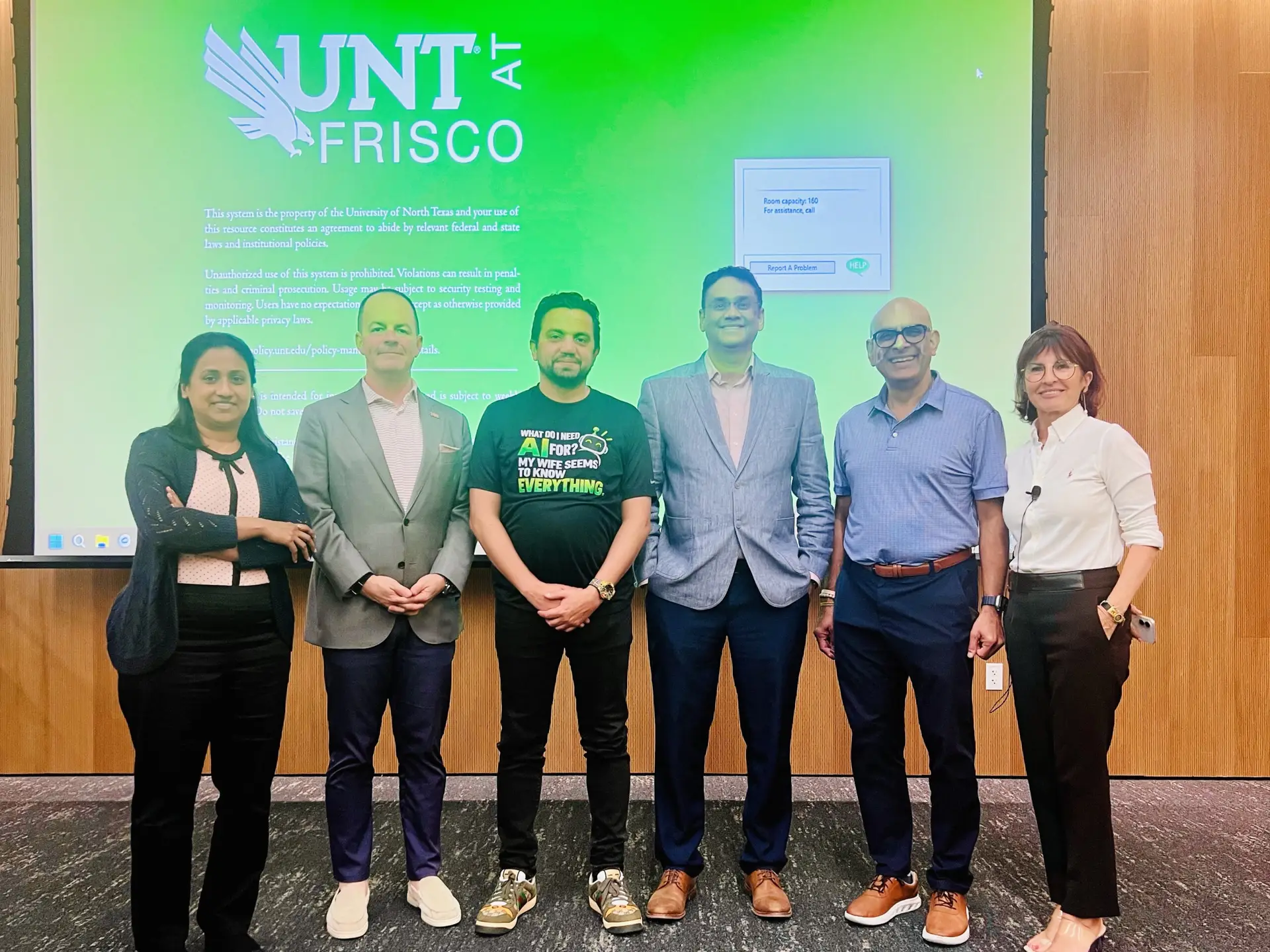
AI and entry-level hiring was the topic of a recent panel at the University of North Texas, hosted by Professor Diana Rabah. Reliable Technology Services CEO Jason Denton joined Peeyush Goyal, Hassan Bawab of Magic Logix, Dr. Uttaram Sawant, and Dr. Vijay Giridhar of Baylor Scott & White Health to talk with students about AI and how to get hired in this economy. This article covers the data behind the shift and what our team recommends for students, parents, and employers.
Why is AI hitting young workers first?
AI is best at the kind of work new hires have always learned on. The Stanford study found the declines were concentrated in occupations where AI is more likely to automate the work, rather than help people do it better.
School teaches codified knowledge: facts, syntax, procedures, anything that can be written down. AI handles codified knowledge well. Experienced workers rely on tacit knowledge, judgment built through years of doing the work and fixing mistakes.
New hires have traditionally built that judgment on routine tasks such as resetting passwords, working first-pass support tickets, writing simple code, and cleaning up data. AI now handles much of that work.
Managed IT is heading toward AI that triages support tickets and suggests likely fixes before a technician opens them. That changes the entry-level job from finding the answer to checking it, which puts a premium on judgment over memorization.
There is a long-term cost for employers, too. Today’s senior engineers started as juniors. If businesses hire fewer juniors now, they will have fewer experienced candidates to choose from in five to ten years.
Where are the jobs coming from?
Mostly from small businesses. They have created 61% of net new American jobs since 1995, according to the SBA Office of Advocacy, and they employ nearly half of all U.S. workers. Between March 2023 and March 2024 alone, they added a net 1.2 million jobs.
Americans are also starting businesses at a record pace. The U.S Census Bureau’s 2025 data reported 5.67 million business applications, the most since the series began. AI tools are likely part of the reason, since one person can now handle work that once took a team.
Many of those new businesses stay small. In July 2026, only about one in four new applications was the kind the Census Bureau considers likely to become an employer, down from about one in three in 2021. The result is more businesses, many of them leaner, with most of the hiring coming from the ones that grow.
For job seekers in Frisco and across North Texas, small IT teams and managed service providers (MSPs) are worth a close look. On a small team, new hires work on networks, security, cloud, and client issues from the start, which builds experience quickly.
What new jobs is AI creating?
Most of the new roles combine AI with security or IT operations. In ISC2’s 2025 Cybersecurity Workforce Study, 41% of security professionals named AI a critical skill, more than any other skill, and AI ranked among the most-needed skills for the second year running.
- AI governance and policy. Businesses are adopting AI faster than they’re governing it. Someone has to decide which tools are approved, what data they can touch, and who checks the output. This fall our team wrote AI use policies and governance frameworks for clients, including a major church.
- Securing AI systems. Each new AI tool connects to company data and accounts, which gives attackers another way in.
- Automation engineering. “A 16-person MSP can’t out-hire the enterprise, but it can out-automate it,” Denton told the students. Our team is building its own private AI on dedicated hardware to automate internal work without sending client data to public models.
- SOC analysts who supervise AI. Security operations centers are moving toward AI that reviews alerts first, with analysts who decide which alerts need a closer look.
- AI cleanup. Employees are adopting unapproved “shadow AI” tools, and AI-written code is showing up in business systems. Both need someone to secure, document, and govern them.
Attackers use AI too. It helps them write convincing phishing emails and take over accounts, and small businesses tend to have the weakest defenses. That keeps security skills in demand at every level.
How do you get an IT job in the AI era?
Show that you can use AI and check its work. Here are the five moves our team would make if we were graduating this year:
- Write an AI use policy for your student organization or a local nonprofit. At RTS, every AI tool goes through an approved list before anyone uses it. A graduate who already thinks that way is ahead of most working professionals.
- Build one automation that solves a real problem, and document it. Write down what data it touches, what you blocked it from seeing, and how you tested it for wrong answers.
- Keep a list of the times AI was confidently wrong and you caught it. In an interview, that one story of judgment is worth more than any certificate on your resume.
- Apply to small businesses and MSPs. You’ll get broader experience faster and work directly with the people who make hiring decisions.
- Practice the human skills. “AI can draft a client update, but it can’t calm a frustrated business owner, earn trust, or build professional relationships,” Denton said. “Those are the people we promote.”
Our team ranks problem solving skills first in every interview. Tools and AI change every year, but the ability to break a messy problem down, test an assumption, and reach a sound answer never goes out of date.
What should parents and business owners do now?
Parents: push for hands-on experience before graduation. Internships, part-time help desk work, and real projects build the tacit knowledge AI can’t replace, and that’s what employers screen for. Send your student our free guide below.
Business owners: three moves protect both your future talent and your data.
- Keep hiring juniors. Train them to verify AI’s work rather than redo it. That’s how you build the experienced team you’ll need in five years.
- Put an AI use policy in place. Your team is already using AI tools, approved or not. A short written policy protects your data and your clients.
- Assume your people are being targeted. AI-written phishing is harder to spot, so security training and controls matter more each year.
Not sure where your business stands on AI? Our team helps North Texas businesses write AI use policies, secure the tools they already use, and train their people to spot AI-powered attacks. Call 972.829.5300 or talk to our team.
Free Guide: How to Get an IT Job
Our team built a “How to Get an IT Job” guide for the students at the UNT panel, and anyone can download it for free. It covers what hiring managers actually look for, how to prepare for an interview, and how to follow up afterward.
Know a student, new grad, or career changer trying to break into IT or cybersecurity? Send this article to them.
About Reliable Technology Services
Reliable Technology Services is a managed IT and cybersecurity provider based in Frisco, Texas. Jason and Melinda Denton co-founded RTS in 2007, and their team now supports businesses across North Texas. Reliable is a three-time Inc. 5000 honoree (2024 to 2026).
Jason Denton is the CEO of Reliable Technology Services, which he cofounded in Frisco in 2007. Reliable provides managed IT and cybersecurity services to small and mid-sized businesses across Dallas-Fort Worth.
Sources
- Brynjolfsson, Chandar, and Chen, “Canaries in the Coal Mine? Six Facts about the Recent Employment Effects of Artificial Intelligence”, Stanford Institute for Economic Policy Research, August 2025
- SBA Office of Advocacy, Frequently Asked Questions About Small Business, 2026
- SBA Office of Advocacy, United States 2025 Small Business Profile
- U.S. Census Bureau, Business Formation Statistics, as reported by The Lonely Entrepreneur (release CB26-130, August 2026)
- ISC2, 2025 Cybersecurity Workforce Study, as reported by Network World